What is it used for?
KISUNLATM is indicated for the treatment of Alzheimer's disease. Treatment with KISUNLA should be initiated in patients with mild cognitive impairment or mild dementia stage of disease, the population in which treatment was initiated in the clinical trials.KISUNLATM is indicated for the treatment of Alzheimer's disease. Treatment with KISUNLA should be initiated in patients with mild cognitive impairment or mild dementia stage of disease, the population in which treatment was initiated in the clinical trials.
Read the primary sourceThis source does not establish current stock, import permission or personal eligibility in China. The treating clinician and provider must confirm these separately.
Product details
- Active ingredient
- donanemabdonanemab
- Form and strength
- INJECTION, SOLUTION · 17.5 mg / 1 mLINJECTION, SOLUTION · 17.5 mg / 1 mL
- Manufacturer / applicant
- ELI LILLY AND COMPANYELI LILLY AND COMPANY
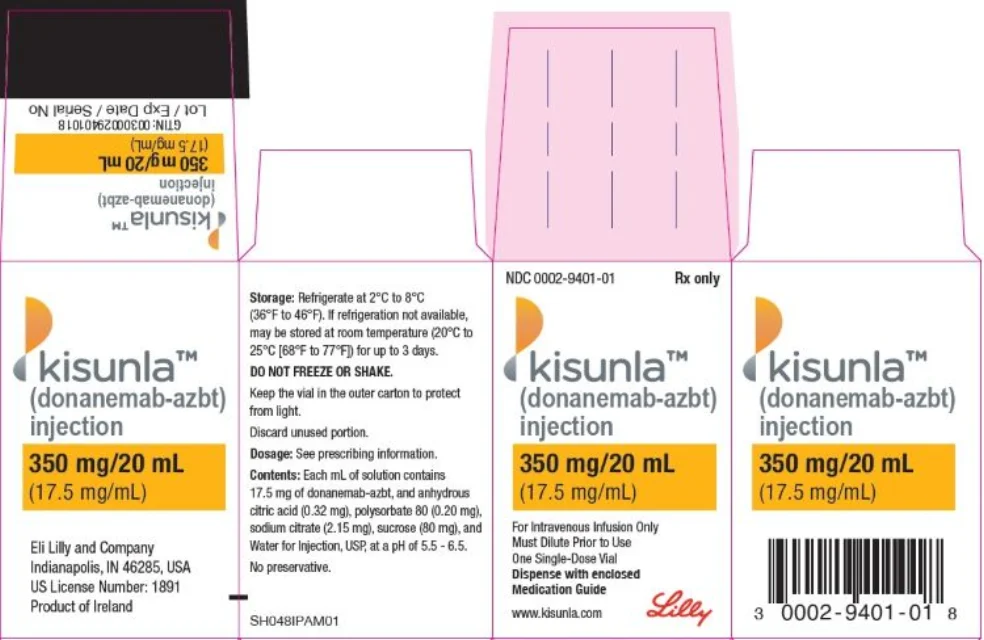
Injection: 350 mg/20 mL (17.5 mg/mL) clear to opalescent, colorless to slightly yellow to slightly brown solution in a single-dose vial.Injection: 350 mg/20 mL (17.5 mg/mL) clear to opalescent, colorless to slightly yellow to slightly brown solution in a single-dose vial.
Safety and clinical review
Monoclonal antibodies directed against aggregated forms of beta amyloid, including KISUNLA, can cause amyloid related imaging abnormalities (ARIA), characterized as ARIA with edema (ARIA-E) and ARIA with hemosiderin deposition (ARIA-H). Incidence and timing of ARIA vary among treatments. ARIA usually occurs early …Monoclonal antibodies directed against aggregated forms of beta amyloid, including KISUNLA, can cause amyloid related imaging abnormalities (ARIA), characterized as ARIA with edema (ARIA-E) and ARIA with hemosiderin deposition (ARIA-H). Incidence and timing of ARIA vary among treatments. ARIA usually occurs early …
- Amyloid Related Imaging AbnormalitiesAmyloid Related Imaging Abnormalities
- Hypersensitivity ReactionsHypersensitivity Reactions
- Infusion-Related ReactionsInfusion-Related Reactions
Ask your clinician to review the complete label, medical history, other medicines, allergies, pregnancy or breastfeeding and any required monitoring. Do not start, stop or change treatment from this page.
Read the primary sourcePrepare your enquiry
Include the brand or generic name, strength, dosage form, requested quantity and country where care is needed. You can attach a prescription when you continue.
Questions patients ask
What is KISUNLA used for?
KISUNLATM is indicated for the treatment of Alzheimer's disease. Treatment with KISUNLA should be initiated in patients with mild cognitive impairment or mild dementia stage of disease, the population in which treatment was initiated in the clinical trials.KISUNLATM is indicated for the treatment of Alzheimer's disease. Treatment with KISUNLA should be initiated in patients with mild cognitive impairment or mild dementia stage of disease, the population in which treatment was initiated in the clinical trials.
This source does not establish current stock, import permission or personal eligibility in China. The treating clinician and provider must confirm these separately.
Which formulation of KISUNLA should I ask about?
INJECTION, SOLUTION · 17.5 mg / 1 mLINJECTION, SOLUTION · 17.5 mg / 1 mL
Read the primary sourceWhat determines the price of KISUNLA?
A current quote depends on the exact presentation, quantity, provider and access arrangements. A catalogue entry is not a stock or delivery promise. Medical charges are paid to the provider, separately from coordination fees.
What should I check before using KISUNLA?
Ask your clinician to review the complete label, medical history, other medicines, allergies, pregnancy or breastfeeding and any required monitoring. Do not start, stop or change treatment from this page.
Sources and review scope
FDA prescribing informationThis source does not establish current stock, import permission or personal eligibility in China. The treating clinician and provider must confirm these separately.